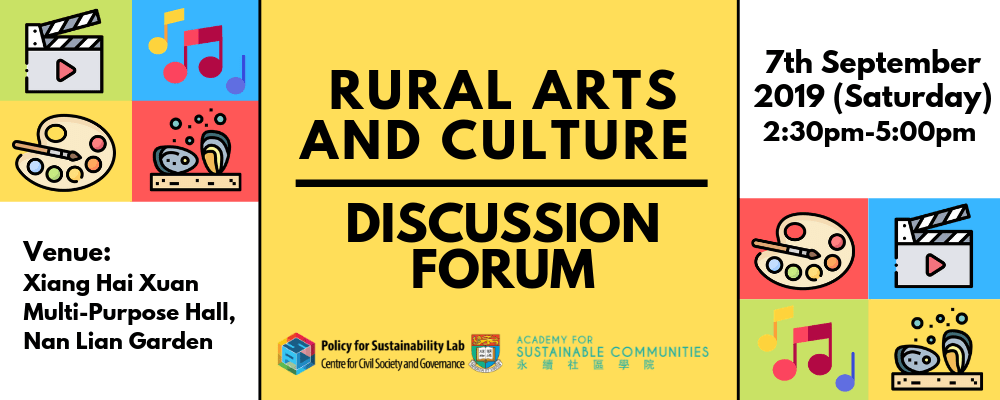
Rural Arts and Culture Discussion Forum
7th September 2019 (Saturday)
14:30 - 17:00

Rural communities are bearers of rich indigenous historical, cultural and social assets, but the inheritance of rural assets is threatened by urbanisation. Guests from the field of Arts and Culture are invited to share their insights on encouraging public access to these assets from four perspectives, namely music and songs, food culture, mixed-media art and films. They will also interact with the audience to explore ways for the sustainable inheritance of these valuable indigenous arts and culture. Participants of the Academy for Sustainable Communities’ public events will be invited to join the Sustainable Communities Fellowship Scheme as Fellows, and will be eligible to apply for the soon to be announced Rural in Action Start-up Scheme.

Date & Time:2:30-5:00pm, September 7, 2019
Venue:Xiang Hai Xuan Multi-purpose Hall, Nan Lian Garden, Diamond Hill, Kowloon
Targets:All are welcome
Programme:Click here
Opening Performance:“Paddy Field of My Heart” children musical performed by Sha Tau Kok Central Primary School
Speakers:Dr Stephen Cheung
Head of Postgraduate Studies, The Hong Kong Academy for Performing Arts
Topic: Hong Kong Traditional Hakka Folk SongsProfessor Sidney Cheung
Professor of the Department of Anthropology, The Chinese University of Hong Kong
Topic: The World is Your Oyster 

Dr Chloe Lai
Urban Diary curator
Topic: Filming Rural Culture in Digital Age

Ms Jaffa Lam
Visual artist
Topic: Lost and Found Culture/Memory through Art

Language:Cantonese
Fee:Free of charge
Enquiry:3917 4768 / ruralsd@hku.hk
Registration:https://hkuems1.hku.hk/hkuems/ec_hdetail.aspx?guest=Y&ueid=66514

Category :   Event

Other Happenings
Event
The APHEN-ICH 2026 International Forum and General Meeting in Hanoi
Preserving Living Heritage in the Asia-Pacific: The APHEN-ICH 2026 International Forum and General Meeting in Hanoi In August 2026, with our colleague Daisy Yeung’s presence, the Centre participated in the APHEN-ICH 2026 International Forum and General Meeting held at Vietnam National University (VNU), Hanoi. Over three days, we immersed in conversations with heritage practitioners, researchers, and community innovators, exploring the theme of Living Heritage and Cultural Industries in the Asia-Pacific: Community Creativity, Sustainable Transmission, and Cultural Innovation. Day 1: Navigating and Sustaining Heritage Discussions centred on how communities are creatively adapting Intangible Cultural Heritage (ICH) through local craft villages, heritage tourism, and digital innovation. What struck us most was the honesty of the practitioners, grappling openly with real tensions: balancing economic benefit with cultural authenticity, and encouraging generational transmission amidst modern career pressures. Rather than viewing marketisation and technology as threats to cultural authenticity, the forum highlighted how creative enterprise can be powerful for transmitting heritage knowledge to younger generations, using digital tools and new market channels,. Day 2: Youth Engagement and the General Meeting The second day speeches focused on youth, ICH and creative futures. The conversation with VNU students showcased their genuine passion for heritage work and a fresh, creative vision for its future. The afternoon APHEN-ICH General Meeting focused on discussing the network's strategic direction for 2026–2028, followed by  a heartfully warm farewell dinner hosted by our VNU colleagues. Day 3: Field Trips to Traditional Craft Villages The forum truly came alive during visits to the Đông Hồ folk painting village and Bát Tràng pottery village. We met a young villager working in community-initiated museums, leading guided tours with passion. He was even developing multilingual self-guided tour elements to make heritage accessible to new audiences — a brilliant example of local youth actively shaping how traditions thrive in the 21st century. When we visited artisans' homes, we heard something you don't find in academic papers: the vulnerability of their position, their pride in their craft, and their pragmatic creativity in adapting the contemporary markets. These exchanges reaffirmed that sustainable transmission it's not about freezing heritage in amber, but enabling communities to choose, adapt and evolve their practices. Looking Forward Our centre recognise that universities must serve as bridges, connecting heritage communities with resources, research support, and platforms for amplifying their voices; supporting young scholars and practitioners in heritage work; and generating knowledge that informs policy and practice. We're energized to deepen our engagement with the APHEN-ICH network and continue to create platforms for dialogue between academics, policymakers, and heritage communities.
Learn more

Organization
Advancing Sustainability Education Through Industry-Relevant Learning
HKU's Master of Social Sciences in Sustainability Leadership and Governance (SLG) programme prepares future leaders to tackle sustainability challenges through interdisciplinary, practical learning. As part of this commitment, we partner with CFA Institute to enhance students’ exposure to industry-recognized knowledge in sustainable investing and ESG integration — bridging academic learning with real-world application. HKU SLG students, alumni, and staff also enjoy special pricing on the Sustainable Investing Certificate. Learn more: https://store.cfainstitute.org/b2b/CCSG/2c352f5899e8174cf1999ded0e419a3d/#/
Learn more
Event
Building an AI-Ready and Inclusive Talent Pipeline
The Centre for Civil Society and Governance (CCSG) at HKU, through the “Jockey Club Collaborative Project for Inclusive Employment,” aims to harness innovation and technology (I&T) to support people with disabilities (PWD) and promote inclusive employment opportunities. In collaboration with GreenTomato, a leading digital transformation consultancy and AI solutions provider, we delivered a job tasting and discovery workshop for the social sector, students, PWD and industry practitioners. Participants learned about and explored how AI is reshaping job design, skill requirements, and inclusive hiring through interactive demonstrations, sharing session and a company tour. Key Highlights: AI localization and new roles: AI localization is creating new, accessible job opportunities, including AI Quality Support roles that align well with the strengths of PWD and SEN talent. Human-in-the-loop importance: Human oversight remains essential to ensure accuracy, compliance, and contextual judgment in AI applications. Shift to AI collaboration: As AI transforms the workplace, competitiveness is increasingly defined by the ability to collaborate with AI, prompting organizations to rethink job design and broaden their talent pipelines. At the Jockey Club Collaborative Project for Inclusive Employment, we are dedicated to fostering cross-sector collaborations that turn digital transformation into inclusive employment opportunities.
Learn more