
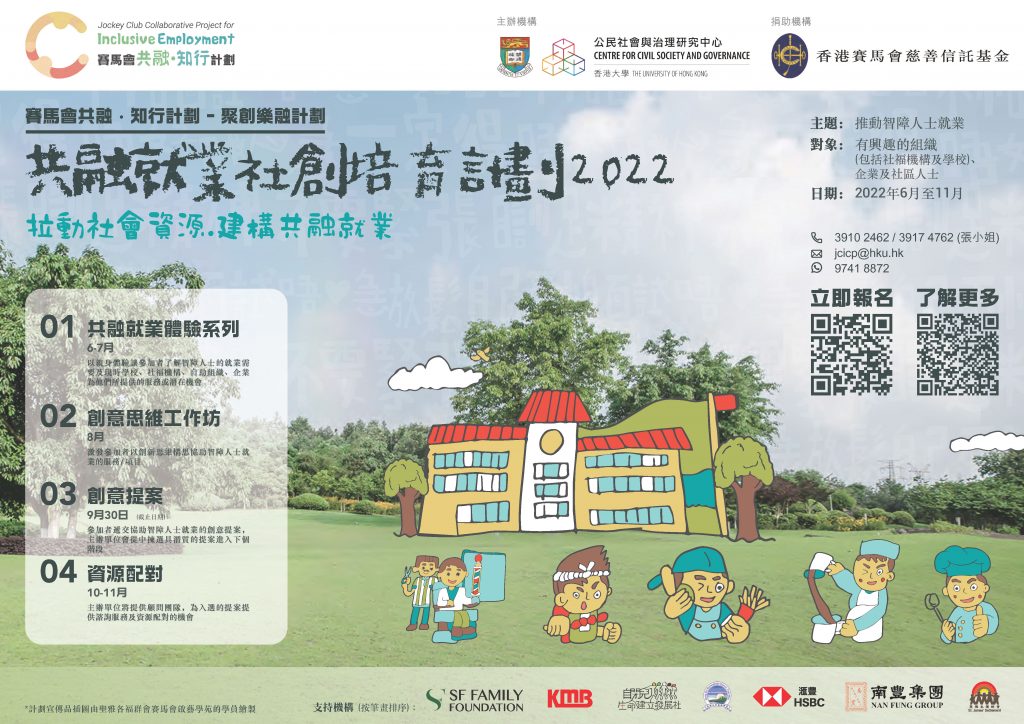
Social Innovation Incubation Programme for Inclusive Employment 2022
10th June 2022 (Friday)

The Jockey Club Collaborative Project for Inclusive Employment is launching the “Social Innovation Incubation Programme for Inclusive Employment” between June and November this year. We would like to invite different community actors and organizations who are passionate about facilitating inclusive employment for people with disabilities to participate in our Programme. Through the Programme participants can enhance their understanding for employment and service channels currently available to people with intellectual disabilities, as well as interact with relevant stakeholders, to expand their resources and network on the topic and therefore generate innovative and influential proposals contributing to inclusive employment.

Programme details are as follow:

Theme:Facilitation of Employment for People with Intellectual Disabilities
Target Participants:Business executives, NGO managers, community actors, students, and members of the public who are interested in the cause of social inclusion
Content:Inclusive Employment Experiential Series(June – July 

To understand the career needs of people with intellectual disabilities, and to understand currently available services and potential opportunities provided by schools, welfare departments, self-help groups and corporates.


Design Thinking Workshop (August)

Ideation of services / projects promoting employment for people with intellectual disabilities through design thinking.


Idea Development (September)

Participants will submit their innovative proposals for screening, in which the organizer will choose the ones with the most development potentials for the next stage


Pitching Activities (October – November)

The organizer will invite a team of consultants to provide consultation and resource-matching opportunities for the shortlisted proposals


Deadline:June 10, 2022 (Friday), 12:00NN


Click here to join the Programme.


Category :   Event

Other Happenings
Event
Sustainability Sharing Seminar for the Retail Sector: Insights & Best Practices
Environmental, Social, and Governance (ESG) considerations are rapidly reshaping the retail landscape across Asia Pacific, driven by evolving consumer expectations and mounting environmental challenges. According to the KPMG GS1 Navigating the Future of Seamless Commerce in Asia Pacific (2024) report[1], only 11% of consumers in 14 Asia-Pacific markets stated that sustainability does not influence their purchasing decisions. The majority actively seek brands with clear sustainability commitments—53% are more likely to choose sustainable products, while significant proportions prioritize waste reduction through recycling (49%), sustainable sourcing of raw materials (31%), and eco-friendly packaging (30%). Additionally, 28% value brands with robust climate action or net-zero strategies, and 22% are concerned with fair labour practices, underscoring ESG as a critical factor in consumer choice. To accelerate ESG progress and foster collaboration, the Hong Kong Retail Management Association (HKRMA), the Faculty of Social Sciences (FOSS) at The University of Hong Kong (HKU), and the Centre for Civil Society and Governance, HKU, co-hosted the Sustainability Sharing Seminar on 21 October 2025. The event convened over 60 sustainability practitioners from 26 leading corporations, SMEs, and non-profit organizations across the retail value chain, providing a dynamic platform for industry dialogue, knowledge exchange, and cross-sector collaboration to advance ESG transformation in Hong Kong’s retail industry.   A Glimpse of Corporate Insights Six esteemed speakers shared their sustainability journeys, offering diverse insights from across the retail landscape. Jane Tong (Giormani), Miko Cheung (LAWSGROUP), Ophelia Lin (Meiriki Japan), Kim Siu (Watsons Water), and Joyce Chiu (Café de Coral) discussed how their companies are weaving sustainability into their strategic DNA. Their approaches emphasize building resilient, future-ready business models that address evolving ESG reporting requirements, growing demand for supply chain transparency, and shifting consumer expectations. Highlights of their strategies include: Championing repair, refurbishment and upcycling to extend product lifespan, promote resource circularity, create new revenue streams, and enhance customer loyalty; Adopting eco-friendly materials and minimalist packaging to reduce waste while ensuring product protection; Integrating employee wellbeing initiatives to boost productivity and support sustainable organisational growth; Fostering youth entrepreneurship and innovation for broader societal impact; Communicating compelling sustainability narratives to stakeholders—including senior management, suppliers, and employees—to align strategic vision, shared purpose, and mutual benefits to galvanise collective action.   Complementing these industry perspectives, Elsa Lam from the FOSS’ Experiential Learning Team provided an academic viewpoint on talent development. She underscored the transformative power of experiential learning to bridge knowledge gaps, cultivate critical skills, and prepare the next generation of sustainability leaders—illustrating the vital synergy between academia and industry in advancing ESG capacity.   Panel Discussion: Key Takeaways The panel discussion distilled several actionable insights: Governance from the Inside Out: Robust governance is fundamental to sustainable success, requiring cross-departmental collaboration and active staff engagement. ESG as Corporate DNA: Sustainability must be embedded in company values, operations, and culture, not treated as an add-on. Purpose-driven management is essential, aligning actions with the company’s mission and addressing broader societal challenges. Commercialising Sustainability: Aligning sustainable practices with market needs transforms environmental and social responsibility into business advantage. Companies can build strong brands, enhance efficiency, and develop circular products and services for new revenue streams and competitive edge. Two-Way Talent Development: Mutual learning between managers and interns fosters a vibrant sustainability culture. Internships serve as practical training for emerging talent, while managers benefit from fresh perspectives, driving innovation and engagement.   Looking Ahead The seminar concluded with renewed optimism and commitment to translating ESG ambitions into impactful action. As Hong Kong’s retail sector advances its sustainability journey, continued collaboration between industry and academia will be essential for fostering a greener, more resilient future.   References: KPMG. (2024). Navigating the future of seamless commerce in Asia Pacific. https://assets.kpmg.com/content/dam/kpmgsites/xx/pdf/2024/06/navigating-the-future-of-seamless-commerce-in-asia-pacific.pdf
Learn more
Event
“Caring Employer” Medal Presentation Ceremony 2025
Under the Jockey Club Collaborative Project for Inclusive Employment, the Centre for Civil Society and Governance are pleased to get involved in formulating the assessment criteria of Diverse Abilities · Inclusive Workplace Recognition Scheme and “Caring Employer” Medal as announced in the Chief Executive’s 2024 Policy Address. Held on 10 October 2025, the presentation ceremony successfully concluded the Medal. It was a privilege for our team to contribute to the vetting process and celebrate this key advancement in disability inclusion in Hong Kong. Read More
Learn more
Event
Festivals of Identity and Community: Intangible Cultural Heritage as a Sense of Belonging
As one of the founding members of the Asia-Pacific Higher Education Network for Safeguarding Intangible Cultural Heritage (APHEN-ICH), we are pleased to have attended the network’s International Field School hosted by the Mongolian National University of Arts and Culture (MNUAC) in partnership with ICHCAP and the APHEN-ICH Secretariat between 21-26 August 2025. Mongolian Nomadic Culture and its Management The Mongolian nomadic culture is deeply rooted in an intimate relationship with nature—traditionally, worshippers of Heaven, Sky and Earth, their beliefs are rooted in interdependence, as well as deep respect and protection for the land.  Their beliefs form an essential part of Mongolia’s intangible cultural heritage, including traditional practices and art form, such as songs, rituals and festivals. As part of the decentralised regional development policy of Mongolia, the Mongolia National Centre for Cultural Heritage identifies and leverages unique characteristics of each region to support and coordinate diversified development, cooperation and specialisation.  This allows a sense of uniqueness among different regions while pursuing a holistic regional vision. Reflecting on Hong Kong’s Rural Revitalisation️ Dr. Jessica Williams and Dr. Vivian Chu presented their work on “Rural Revitalisation: Collaborative Governance for Harnessing Cultural Heritage”.  CCSG advocates for a more holistic village cluster approach in rural revitalisation.  Having started our revitalisation efforts in Lai Chi Wo, we extended them to Mui Tsz Lam and Kop Tong, where our projects focus on identifying and building on natural and cultural assets of each village.  The effect is that the facilities, activities and resources offered by the villages can complement one another and collectively more value is generated for society.  This sparked lively discussion amongst the participants regarding policies and strategies to build more supportive environments for ICH transmission.
Learn more