
Festivals of Identity and Community: Intangible Cultural Heritage as a Sense of Belonging
21st August 2025 (Thursday)

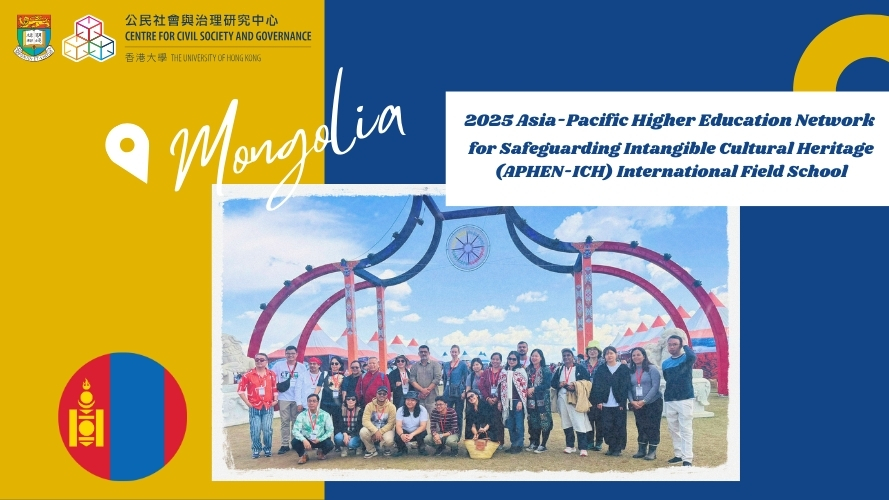
As one of the founding members of the Asia-Pacific Higher Education Network for Safeguarding Intangible Cultural Heritage (APHEN-ICH), we are pleased to have attended the network’s International Field School hosted by the Mongolian National University of Arts and Culture (MNUAC) in partnership with ICHCAP and the APHEN-ICH Secretariat between 21-26 August 2025.

Mongolian Nomadic Culture and its Management

The Mongolian nomadic culture is deeply rooted in an intimate relationship with nature—traditionally, worshippers of Heaven, Sky and Earth, their beliefs are rooted in interdependence, as well as deep respect and protection for the land.  Their beliefs form an essential part of Mongolia’s intangible cultural heritage, including traditional practices and art form, such as songs, rituals and festivals. As part of the decentralised regional development policy of Mongolia, the Mongolia National Centre for Cultural Heritage identifies and leverages unique characteristics of each region to support and coordinate diversified development, cooperation and specialisation.  This allows a sense of uniqueness among different regions while pursuing a holistic regional vision.

Reflecting on Hong Kong’s Rural Revitalisation

Dr. Jessica Williams and Dr. Vivian Chu presented their work on “Rural Revitalisation: Collaborative Governance for Harnessing Cultural Heritage”.  CCSG advocates for a more holistic village cluster approach in rural revitalisation.  Having started our revitalisation efforts in Lai Chi Wo, we extended them to Mui Tsz Lam and Kop Tong, where our projects focus on identifying and building on natural and cultural assets of each village.  The effect is that the facilities, activities and resources offered by the villages can complement one another and collectively more value is generated for society.  This sparked lively discussion amongst the participants regarding policies and strategies to build more supportive environments for ICH transmission.

Category :   Event

Other Happenings
Event
Building an AI-Ready and Inclusive Talent Pipeline
The Centre for Civil Society and Governance (CCSG) at HKU, through the “Jockey Club Collaborative Project for Inclusive Employment,” aims to harness innovation and technology (I&T) to support people with disabilities (PWD) and promote inclusive employment opportunities. In collaboration with GreenTomato, a leading digital transformation consultancy and AI solutions provider, we delivered a job tasting and discovery workshop for the social sector, students, PWD and industry practitioners. Participants learned about and explored how AI is reshaping job design, skill requirements, and inclusive hiring through interactive demonstrations, sharing session and a company tour. Key Highlights: AI localization and new roles: AI localization is creating new, accessible job opportunities, including AI Quality Support roles that align well with the strengths of PWD and SEN talent. Human-in-the-loop importance: Human oversight remains essential to ensure accuracy, compliance, and contextual judgment in AI applications. Shift to AI collaboration: As AI transforms the workplace, competitiveness is increasingly defined by the ability to collaborate with AI, prompting organizations to rethink job design and broaden their talent pipelines. At the Jockey Club Collaborative Project for Inclusive Employment, we are dedicated to fostering cross-sector collaborations that turn digital transformation into inclusive employment opportunities.
Learn more
Event
“Celebrating Traditional Wisdom Through Art” Exhibition – Can contemporary art bring new imaginations into centuries-old village traditions?
A new exhibition, “Celebrating Traditional Wisdom Through Art,” will be hosted at the iconic Fringe Club in Central this June. This unique exhibition showcases how sustainability, cultural heritage, and creative expression come together. Since late last year, our Centre has been working with a group of emerging artists where they embarked on an incubation journey in the 300-year-old Hakka village of Lai Chi Wo. Drawing inspiration from the village's rich heritage and landscape, 15 artists have translated their experiences into contemporary artworks centered around three core elements: Soil, Plants, and Sound. From natural dyes created from native plants to soundscapes recorded in the village and ceramic creations, the exhibition offers a refreshing sensory exploration of rural sustainability and community resilience. Exhibition Details: Date: 16-23 June 2026 Time: 10:00 AM - 9:00 PM Venue: Anita Chan Lai-ling Gallery, The Fringe Club, Central (Google Map) For more information, please visit: https://www.instagram.com/villagelifezine/
Learn more
Event
A Dialogue on Building Resilient Urban-Rural Partnerships
To kick off our conference and network launch event for the Network for the Study of Social-Ecological Systems (SES) Transformations, the Centre for Civil Society and Governance hosted a public dialogue on “Building Resilient Urban-Rural Partnerships.” We were very pleased to welcome network members from across the Asia-Pacific region, alongside practitioners, government representatives, and guests from Hong Kong to the event. We would like to sincerely thank Professor Samson Tse, Acting Dean of the Faculty of Social Sciences and Ms. Linda So, JP, Director of the Northern Metropolis Co-ordination Office, for delivering the opening remarks. Ms. So’s opening speech was both inspiring and timely, reinforcing the importance of advancing nature-based solutions and sustainable practices as well as the government’s understanding of the challenges and opportunities in building a resilient and sustainable future through the Northern Metropolis Development. We were also honoured to have Professor Yahua Wang (Tsinghua University) and Dr. Ruth Meinzen-Dick(International Food Policy Research Institute) as our keynote speakers. Professor Wang explained the challenges of applying the SES framework across contexts due to variability in variable selection and interpretation, while also highlighting the importance of complexity, robustness, collaborative networks, and the potential for integrating AI and SES research. He also reflected on the importance of collaborative networks in working toward a more common SES language. Building on this, Dr. Meinzen-Dick spoke to the importance of bridging theory and practice, transdisciplinarity, and building connections across people, institutions, and disciplines. She highlighted the importance of engaging with property rights and collective action in robust ways, and reflected on how experiential learning fosters collective action. We were pleased to also offer a panel session featuring Professor Maiko Nishi, Professor Ching-Ping Tang, Professor Stephen M.B. Tang, and our Centre Director Professor Wai-Fung Lam. Dr. Winnie Law led a fruitful discussion on critical issues such as challenges in evaluating and understanding social-ecological systems beyond conventional metrics, including how to capture the broader social, ecological, and long-term impacts of these systems and partnerships. Thank you once again to all keynote speakers, panelists, participants, and guests for contributing to such a thoughtful discussion.
Learn more