
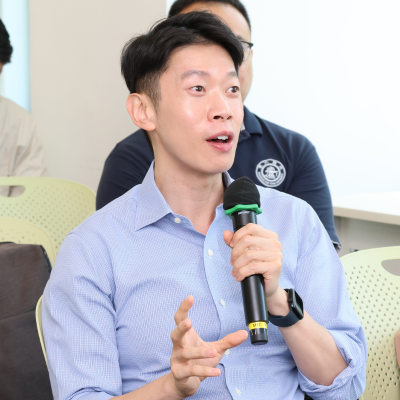
Prof. Kwan Nok Chan researches the role of information in public policy. He combines classic theories of institutions in the public policy literature with notions of information processing from behavioral science and information theory to understand how communities organize themselves to overcome uncertainty, cognitive overload, attentional biases, and other informational inefficiencies to deliver effective governance.
A number of his past projects were concerned with information processing inside government bureaucracies. Drawing on an original dataset spanning decades of policymaking in Hong Kong and the Chinese mainland, these studies revisit assumptions prevalent in public policy theories of information processing and suggest modifications to improve their generalizability in comparative applications. More recently, his team has sought to further develop information processing theory, this time focusing on how policy information varies qualitatively across domains and how that variation, in turn, reshapes intra-governmental exchange. Recent publications and working papers include additional research on oversight and disclosure as policy tools to address informational challenges in environmental regulation and ESG.
Combining information processing with the Center’s long-term interest in the commons and collective action, his team investigates how institutional choice is associated with the quality of peer-produced content in online encyclopedias and other open-access communities, whose effective governance bears critically upon social and economic growth in the digital era. Another project compares the patterns of AI integration in public service among street-level bureaucrats in Shanghai, Taipei, and Seoul, where pre-existing information-processing arrangements are found to determine the scale and extent of AI integration in many important public service scenarios.
• “Buffering or Binding? Political Connections and Firms’ Sustainability Disclosure Strategies in China” (with Mengqi Xie and Qichang Ma). Organization & Environment (In press).
• “Political leadership, preference disclosure, and regulatory behavior: China’s film regulation in the information processing perspective.” (with Hongchuan Wang and WF Lam). Journal of Public Policy (2026): 1-18.
• “Using simulations of future extreme weather events to escape the resilience trap: Experimental evidence from Hong Kong.” (With Terry van Gevelt and others). International Journal of Disaster Risk Reduction 115 (2024): 105020.
• “Public administration in authoritarian regimes: propositions for comparative research.” Asia Pacific Journal of Public Administration (2024): 1-23.
• “When blame avoidance meets transparency: local governments’ bandwagon strategy in environmental information disclosure in China.” (with Shaowei Chen and Kai Jia). Local Government Studies (2024): 1-21.
• “Using Virtual Simulations of Future Extreme Weather Events to Communicate Climate Change Risk” (with Terry van Gevelt, Brian G McAdoo, Jie Yang, Linlin Li, Fiona Williamson, Alex Scollay, Aileen Lam, and Adam D Switzer). PLOS Climate. (2023)
• “Individual Perceptions of Climate Anomalies and Collective Action: Evidence from an Artefactual Field Experiment in Malaysian Borneo” (with Terry van Gevelt, T Zaman, and M.M. Bennett). World Development Sustainability. (2022)
Awarded the 2022 Best Article Award for offering “an excellent example on an interdisciplinary approach by borrowing elements from psychology, economics and climate science with robust methodologies and insights from people living in climate-vulnerable areas.”
• “Social Expectations for Charitable Giving in China” (with Lin Nie and Wai Fung Lam). Nonprofit and Voluntary Sector Quarterly. (2022)
• “Elite Bargains and Policy Priorities in Authoritarian Regimes: Agenda Setting in China under Xi Jinping and Hu Jintao” (with Shaowei Chen and Wai Fung Lam). Governance. (2020)
• “Friction and Bureaucratic Control in Authoritarian Regimes” (with Shiwei Fan).
Regulation & Governance. (2020)
• “Legislative Rules in Electoral Authoritarian Regimes” (with William Bianco and Regina Smyth). The Journal of Politics. 81(2): 892-905. 2019.
• “Bureaucratic Control and Information Processing: An Institutional Comparison” (with Wai Fung Lam). Governance, 31(3): 575-592. 2018.
• “Policy Advocacy in Transitioning Regimes: Comparative Lessons from the Case of Harbour Protection in Hong Kong” (with Wai Fung Lam). Journal of Comparative Policy Analysis: Research and Practice, 19(1):54-71. 2017.
• “Punctuated Equilibrium and the Information Disadvantage of Authoritarianism: Evidence from the People’s Republic of China” (with Shuang Zhao). Policy Studies Journal, 44 (2): 134-155. 2016.
Selected as one of Editor’s Choice articles for offering “an innovative extension of Punctuated Equilibrium Theory to explain policy making processes in an authoritarian regime, providing new insights into a regime type understudied in the public policy field.”
• “How Authoritarianism Intensifies Punctuated Equilibrium: The Dynamics of Policy Attention in Hong Kong” (with Wai Fung Lam). Governance, 28: 549–570. 2015.