


Home » Session 2: NbS Principles, Criteria and Indicators
Nature-based Solutions for Major Societal Challenges
Session 2: NbS Principles, Criteria and Indicators
While there are principles and criteria setting out the operational framework, NbS is often subject to individuals’ and organisations’ own interpretation and claims. There have been concerns that NbS is a ‘dangerous distraction’ being co-opted by corporations for greenwashing, promoting unsustainable and unjust practices such as monoculture plantations and land grabbing from Indigenous communities for carbon offset projects (Global Youth Biodiversity Network, 2021; Melanidis & Hagerman, 2022). In 2022, organisations like the World Rainforest Movement, Indigenous Climate Action, Third World Network and others released a statement ‘NO to Nature Based “Solutions”’, saying that:
‘The companies with “nature-based solutions” in their climate action plans intend to increase their production of highly polluting products. In the flawed logic of corporate “nature-based solutions”, more pollution means that corporations will need to claim more land as their carbon storage facility; it will mean more dispossessions and more restrictions on peasant farming and community use of their territories. It will also mean even more corporate control over lands and forests.’ (World Rainforest Movement, 2022)
To offer guidance for the implementation of NbS, IUCN has set the following eight principles, which were endorsed at the 2016 IUCN World Conservation Congress (IUCN, 2016):
- NbS embrace nature conservation norms and principles
- NbS can be implemented alone or in an integrated manner with other solutions to societal challenges
- NbS are determined by site-specific natural and cultural contexts (including traditional, local and scientific knowledge)
- NbS produce societal benefits in a fair and equitable way in a manner that promotes transparency and broad participation
- NbS maintain biological and cultural diversity and the ability of ecosystems to evolve over time
- NbS are applied at a landscape scale
- NbS recognise and address the tradeoffs between the production of a few immediate economic benefits for development, and future options for the production of the full range of ecosystems services
- NbS are an integral part of the overall design of policies, and measures or actions, to address a specific challenge
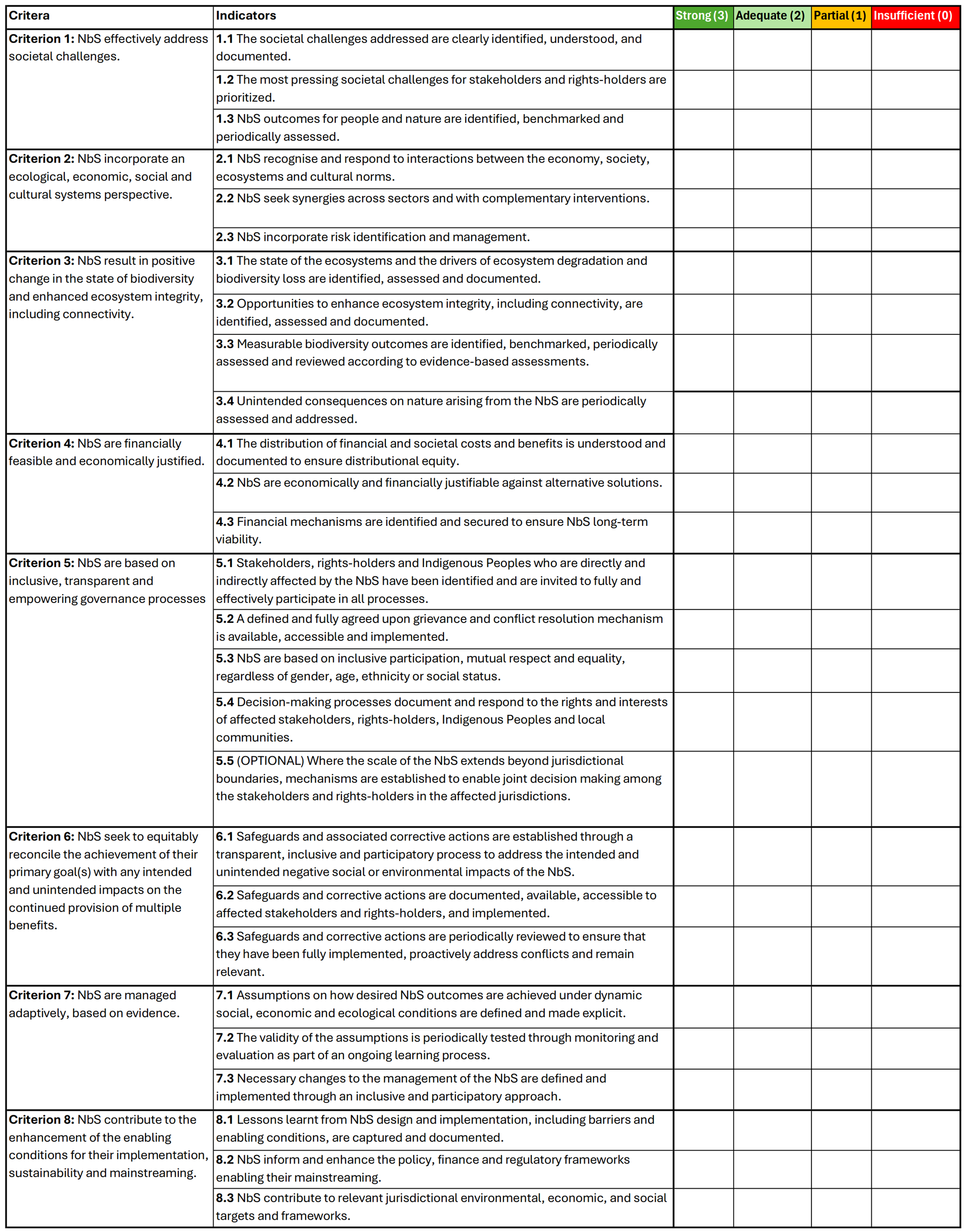
In response to the misuse of the NbS concept, IUCN further developed the IUCN Global Standard for Nature-based Solutions (NbS-GS) based on the above principles and feedback from consultations. The NbS-GS, consisting of eight interconnected Criteria and 28 Indicators, was adopted at the 2021 IUCN World Conservation Congress by 128 state and subnational members. The second edition of the NbS-GS (https://inbs.iucn.org/) was launched in late 2025 to enhance clarity, usability and safeguards (see Table 3 for the 8 criteria and 27 indicators of the second edition).
The NbS-GS provides a framework for the design, verification and scaling up of NbS and is applicable to both landscape-level initiatives and localised interventions (IUCN, 2020a). IUCN and professionals in the field have stressed that the framework is not intended for certification but is designed for self-assessment at different stages of the project to foster iterative learning and reflection. The framework is meant to be a self-reflecting process that can be used as early as the planning stage for decision-makers to review, compare and enhance their NbS proposals.
IUCN has provided an online self-assessment tool for users to plan and manage NbS projects based on the NbS-GS (Table 3). If any indicator receives a ‘Partial’ or ‘Insufficient’ rating, that means the intervention should be improved in the future.
Table 3: Criteria and Indicators of the Second Edition of the IUCN Global Standard for NbS and the Rating in the Self-assessment Tool
Continue to 'Session 3: Policy Instruments for NbS'
© 2026 Centre for Civil Society and Governance at The University of Hong Kong
Except where otherwise noted, contents of this e-study is licensed under a Creative Commons Attribution-NonCommercial-ShareAlike 4.0 License.