

Home » Catalysing Finance and Investment
Nature-based Solutions for Major Societal Challenges
Catalysing Finance and Investment
While public funds, such as grants and subsidies, are common economic and fiscal instruments for NbS, they are often limited (Martin et al., 2025). Water funds and offset programmes are among emerging financial mechanisms. The examples of the Quito Water Fund in Ecuador, the ‘Programa Nascentes’ offset programme in São Paulo, and the ‘Naturcent’ offset programme in Hamburg will be introduced below.
Water funds are organisations that bring together public, private and civil society actors to promote water security through NbS. In Quito, Ecuador, the Quito Water Fund (FONAG) created by the Public Metropolitan Drinking Water and Sanitation Company (EPMAPS – Quito Water) and the non-profit organisation (NPO) The Nature Conservancy is an alliance of individuals, institutions, and communities that protects Quito’s water source ecosystems from threats such as climate change and land degradation. Founded in 2000 as a privately managed commercial trust for a period of 80 years, FONAG is the world’s first water fund. Constituents of FONAG include major water users in the area (water and electricity, breweries, and bottled water) and their financial contributions vary based on their contractual commitments (FONAG, 2019). As the Metropolitan District of Quito (DMQ) has an ordinance requiring 2% of the revenue collected by EPMAPS – Quito Water from the bills paid by users to be allocated to the protection of water basins which supply water to DMQ, FONAG’s financial sustainability is guaranteed (FONAG, n.d.b). Independent trust managers invest the funds’ assets in financial markets and allocate the income to different stakeholder groups to fund water protection actions according to the fund’s contractual arrangements (Birch et al., 2023). FONAG has recovered and restored over 17,800 ha of land and improved Quito’s water quality and supply (FONAG, n.d.a). With its inclusive finance mechanism and participatory governance structure, FONAG works as a successful model for promoting NbS amid environmental stress and government fiscal constraints. The model has been replicated in Latin America and other parts of the world (Verónica Sánchez, 2025).
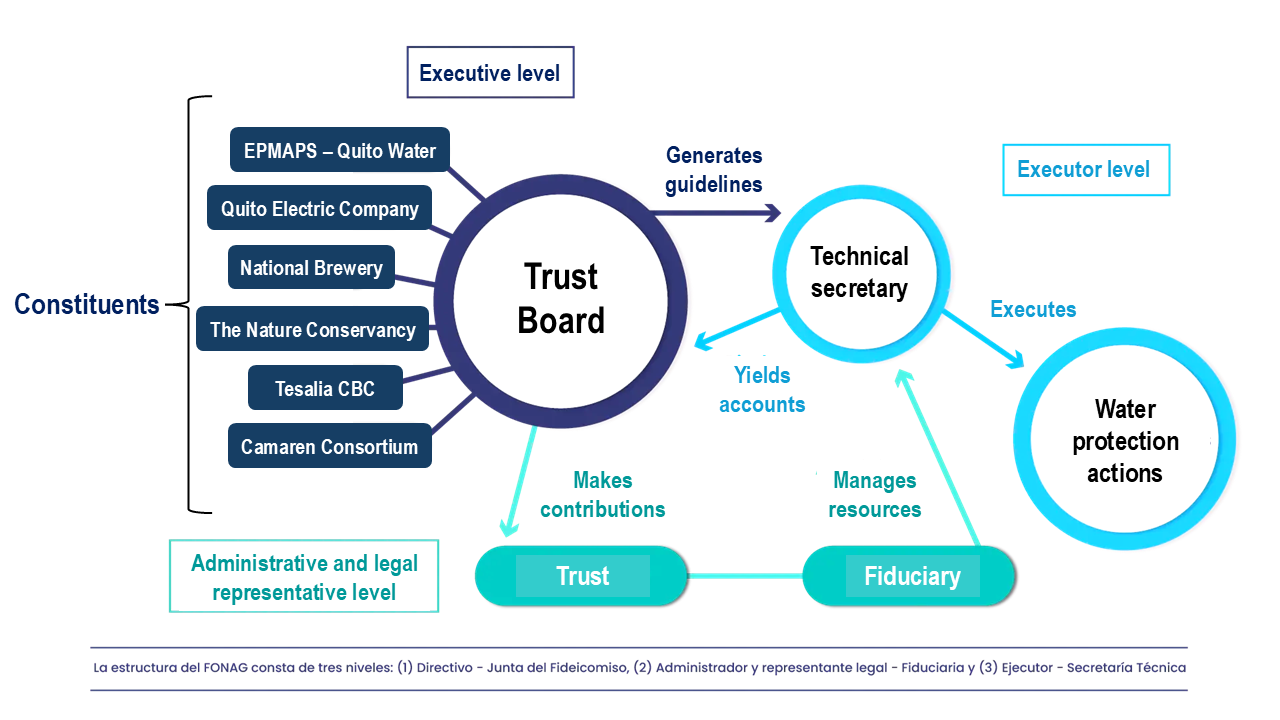
Diagram adapted from FONAG Structure, by FONAG, n.d.b
In Brazil, the government of São Paulo has been promoting water security and biodiversity conservation through the ‘Programa Nascentes’ (Springs Programme) since 2015. The programme houses an online platform that connects companies needing to offset environmental damage with landowners in the Atlantic Forest willing to restore their land. The goal of restoring 20,000 ha was achieved in 2020 and the programme is aiming to restore another 10,000 ha by 2030 (United Nations Decade on Ecosystem Restoration 2021-2030, n.d.; Secretaria de Meio Ambiente, Infraestrutura e Logística, 2025).
In Germany, the ‘Naturcent’ programme in Hamburg, launched in 2016, funds ecological and recreational improvements in green areas through land taxes on new real estate development. Revenue from higher taxes from building activities in designated landscape protection areas is allocated to a municipal conservation fund. Districts and environmental organisations in Hamburg can apply for this fund to invest in upgrading and maintaining green spaces (Toxopeus, 2019). As of 2020, Naturcent has collected an average of 3 million Euros per year (ICLEI East Asia, 2020).
Continue to 'Generating and Sharing New Knowledge'
© 2026 Centre for Civil Society and Governance at The University of Hong Kong
Except where otherwise noted, contents of this e-study is licensed under a Creative Commons Attribution-NonCommercial-ShareAlike 4.0 License.