

Home » Fostering Cross-sectoral Collaboration
Nature-based Solutions for Major Societal Challenges
Fostering Cross-sectoral Collaboration
Inclusive and multidisciplinary stakeholder engagement in co-design and co-creation during all stages of NbS implementation is very important (Martin et al., 2025). An effective collaboration for NbS would facilitate the individual stakeholders and parties to act and contribute towards a shared NbS goal with agreed sets of rights and responsibilities. In Flanders, a flood-prone region in Belgium, the Flemish Environment Agency introduced the concept of ‘river contracts’ for relevant stakeholders of local river catchments to engage and collaborate in defining and implementing solutions for water related issues, such as flooding, water scarcity, poor water quality and soil erosion. The River Contracts initiative is an example of agreement-based or cooperative instruments that can promote collaboration for NbS across scales and sectors.
A river contract is a non-legally binding but shared commitment which outlines the measures to be taken by the involved partners, securing collaboration. The participatory process starts with the establishment of a steering committee comprising representatives from local, provincial, and Flemish authorities, and in some cases, also citizens and civil society organisations. They jointly draft and sign a charter declaring that their intention ‘to work together for solutions with an open mind’. Relevant stakeholders, including local residents, businesses and associations, are then invited to share ideas for addressing water catchment issues through offline forums and an online idea platform. All the action ideas are reviewed and studied, and the most suitable ones are incorporated into a river contract. Under each action, the stakeholders responsible for implementation are specified. By signing the river contract, the involved partners commit to its implementation. Ongoing citizen involvement is ensured via a consultation platform. The involvement of a diversity of stakeholders promotes stakeholder ownership and fosters broad support and commitment to the proposed actions (Devroede et al., 2016; INTERLACE, 2023).
Take the valley of the Dommel as an example, 46 actions are incorporated in the Dommel River Contract to address the themes of flooding, drought, water quality, and water experience. Examples of the actions include ‘river and valley restoration of the Dommel and the Bolissenbeek near Hoksent / Special Protection Zone (SBZ) Dommel Valley’ and ‘combating water scarcity and drought by retaining water in natural areas’. Governmental authorities involved in the partnership include the cities and municipalities of Peer, Lommel, Pelt and Hechtel-Eksel, province of Limburg, as well as Flemish government agencies such as the Flemish Environment Agency, Agency for Nature and Forests, Department of Agriculture and Fisheries, Flemish Land Agency, and Department of Environment. Other partners include an independent volunteer association ‘Natuurpunt’, an association of farmers and horticulturists ‘Boerennatuur Vlaanderen’, a Research and Training Center for Agriculture ‘Proef- en vormingscentrum voor de Landbouw’, a professional organisation for agricultural entrepreneur ‘Boerenbond’, grid company ‘Fluvius’, a water board ‘Watering De Dommelvallei’, the Integrated Water Policy Meuse Basin, and a delegation of the involved citizens.
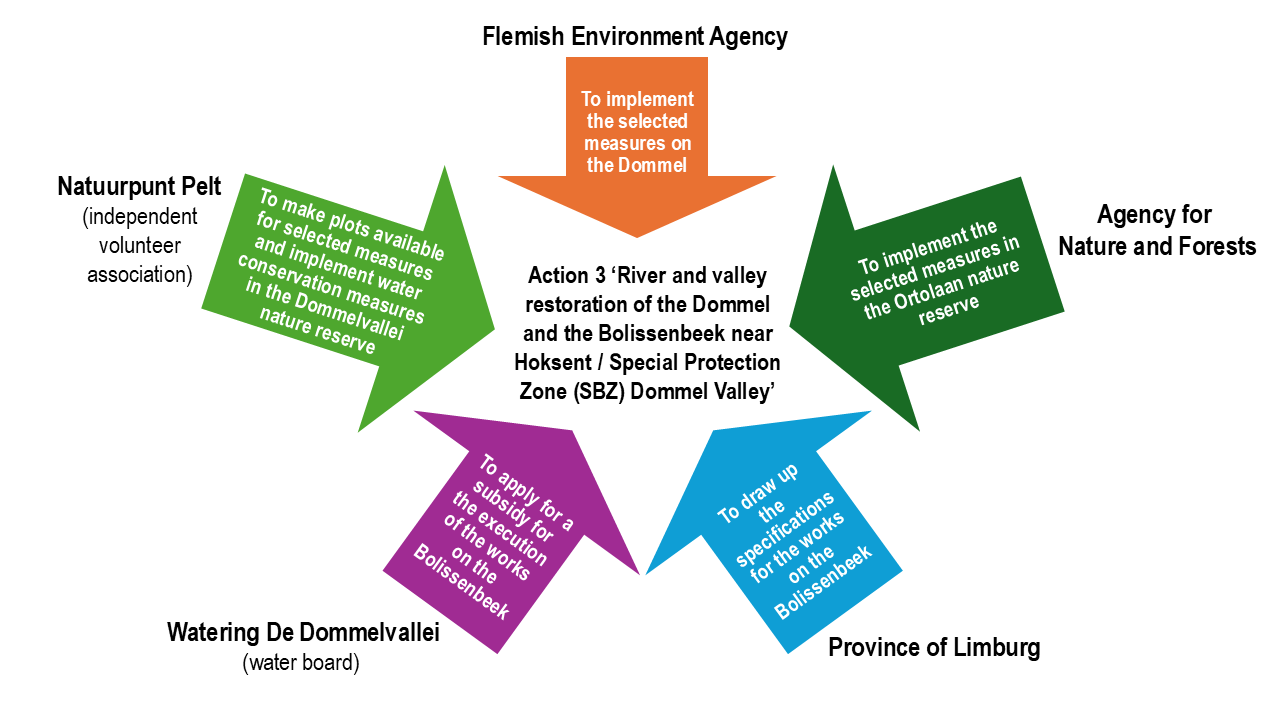
Image drawn by authors
Continue to 'Catalysing Finance and Investment'
© 2026 Centre for Civil Society and Governance at The University of Hong Kong
Except where otherwise noted, contents of this e-study is licensed under a Creative Commons Attribution-NonCommercial-ShareAlike 4.0 License.