


Home » Case 2: ‘Qiandao Lake Water Fund’ Programme in Hangzhou, China
Nature-based Solutions for Major Societal Challenges
Case 2: ‘Qiandao Lake Water Fund’ Programme in Hangzhou, China
#Water security #Human health #Environmental degradation and biodiversity loss #Economic and social development #Climate change #Disaster risk
Qiandao Lake in Chun’an, Zhejiang Province is the most important source of drinking water for the region of Hangzhou and surrounding cities in China, but its water quality has declined. The government has introduced World Bank loans for the ‘Qiandao Lake and Xin’an River Basin Water Resources and Ecological Environment Protection Project’ (靳彤 et al., 2021). The project was officially launched in 2018 with the ‘Qiandao Lake Water Fund’ programme as an innovative initiative, introducing a new approach of multi-party governance for the same river basin and applying NbS to water source protection (Iseman & Miralles-Wilhelm, 2021穆泉 et al., 2023).
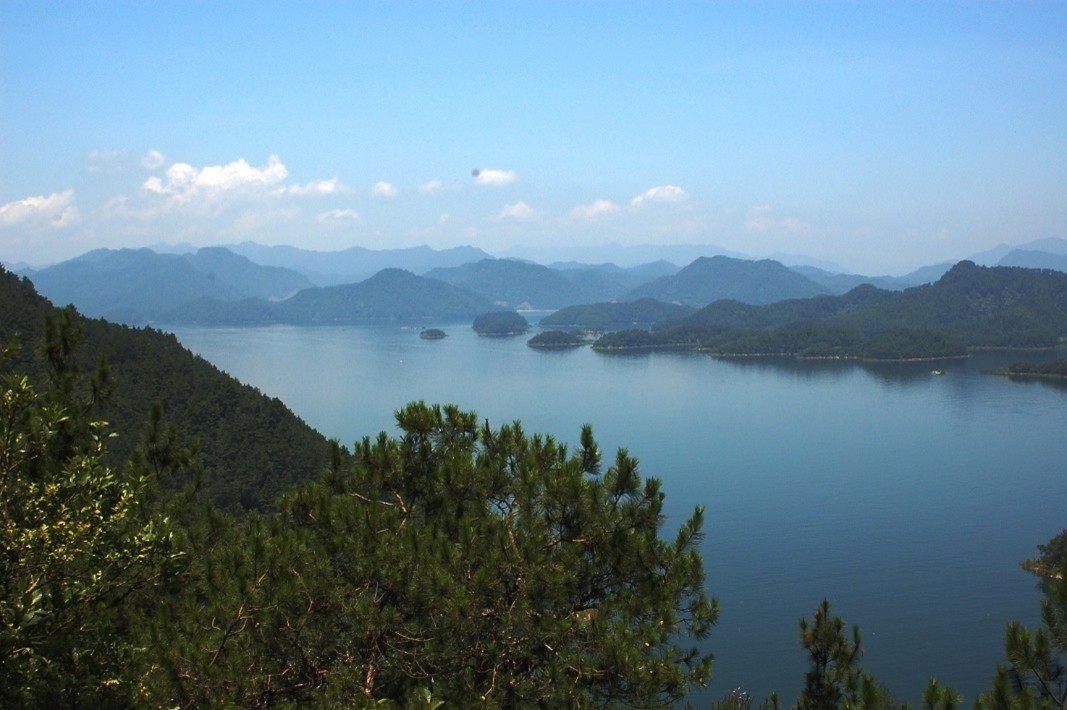
Image from Thousand Island Lake or Qiandao Lake taken from atop a bell tower [Photograph],
by ZHart, 2008, Wikipedia
(https://en.wikipedia.org/wiki/Qiandao_Lake#/media/File:Thousand_Island_Lake.JPG).

CC BY 3.0
NbS-GS Criterion 1: NbS effectively address societal challenges
The eco-friendly water resources protection in Qiandao Lake aimed to address the following societal challenges:
- Water security and human health: Qiandao Lake is the most important source of drinking water for the region of Hangzhou and surrounding cities, but the water quality in Qiandao Lake has declined due to agricultural NPS pollution from excessive application of chemical fertilizers, pesticides and herbicides. Water quality improvement was identified as the main goal of the programme (Davies et al., 2024).
- Environmental degradation and biodiversity loss: Agricultural NPS pollution needs to be controlled because it is found to be an important cause of water pollution in Qiandao Lake and would lead to the risk of water quality degradation. Biodiversity conservation at the watershed of Qiandao Lake is very important because it is situated in the Huangshan-Huaiyushan biodiversity protection priority area of China and acts as a key ecological buffer in the Yangtze River Delta region (大自然保护协会, 2022).
- Economic and social development: The watershed is dominated by smallholder farmers. Long-term agricultural NPS pollution control must be integrated with the livelihood of local farmers and requires a transition to a green economy (Fan et al., 2022).
- Climate change and disaster risk: The Qiandao Lake Basin is vulnerable to disasters such as flash flooding and landslides brought by extreme weather exacerbated by climate change (Davies et al., 2024).
NbS-GS Criterion 2: NbS incorporate an ecological, economic, social and cultural systems perspective
The eco-friendly water resources protection in Qiandao Lake was planned at the whole watershed scale. The watershed was analysed to find out the sources and distribution of agricultural NPS pollutants, and then priority treatment plots were identified. Based on the watershed analysis and onsite socio-economic feasibility study, the ‘Qiandao Lake Water Fund’ programme selected the Shangwuxi sub-watershed in Anyang, Chun’an County as the pilot site. A series of eco-friendly water resources protection practices have been implemented in the tea gardens and rice fields, improving the water quality while protecting the ecology, compensating villagers, and developing rural green industries.
Based on the payment for ecosystem services concept, the ‘Qiandao Lake Water Fund’ programme has established the water fund model as a sustainable mechanism for large-scale implementation of watershed protection projects. It integrates corporate, social and charity resources to synergise environmental conservation, industrial investment and business collaboration.
NbS-GS Criterion 3: NbS result in positive change in the state of biodiversity and enhanced ecosystem integrity, including connectivity
In the pilot site, eco-friendly water resources protection practices, including precision fertilization, cover crops, and ecological prevention and control, have been implemented in the tea gardens and rice fields. Ecological wetlands and ecological ditches were also constructed to intercept and filter out pollutants. The site has been established as a demonstration base of ‘source reduction + process intercept + end-of-pipe treatment’ for NPS pollution control. The monitoring and assessment done by Zhejiang A&F University showed that green manure replacing 10% of chemical fertilisers can reduce nitrogen and phosphorus loss by 30-40% in the demonstration rice fields while increasing rice yield by 11.8%; mulching in the demonstration tea gardens can increase soil fertility while reducing 57.31% of total phosphorus and 44.03% of total nitrogen in runoff. Ecological ditches can increase biodiversity and reduce chemical oxygen demand (COD) in runoff by 15% and reduce the loss of total phosphorus and total nitrogen by 15%-20% (大自然保护协会, 2022).
Based on the pilot results, the programme has identified suitable eco-friendly water resources protection practices (effective, inexpensive, and easily acceptable by farmers) and developed implementation guidance toolkits. To promote the eco-friendly water resources protection practices to the whole watershed in a standardised manner, the programme has developed the digital platform ‘Water Gardian’ in collaboration with Ant Group by leveraging blockchain and AI technologies. With the help of the platform, the area of ecological water conserving agriculture has exceeded 5,000 mu in 2020. It was expected that the area of ecological water conserving agriculture would be extended to 75,000 mu in 2024, reducing 10% of NPS pollution for the whole watershed, and reducing greenhouse gas emissions by over 6,000 tons of CO2e (大自然保护协会, 2022).
NbS-GS Criterion 4: NbS are financially feasible and economically justified
The ‘Qiandao Lake Water Fund’ programme was launched in 2018 with an initial philanthropic funding of CNY 10 million secured by a partnership in which the Alibaba Foundation and the Minsheng Tonghui Foundation jointly established the ‘China Water Source Protection Charity Trust’ with Wanxiang Trust as the trustee and The Nature Conservancy (TNC) as the scientific advisor (Iseman & Miralles-Wilhelm, 2021). In the fourth year of the programme, the Alibaba Foundation further donated CNY 5 million to the Fund. While the philanthropic funding was for water source protection and ecological compensation, the programme has also established a social enterprise ‘Huku’ to invest in and develop eco-agriculture products as well as education and eco-tourism activities, generating profits for the watershed protection programme and creating multiple channels for stakeholders to engage in watershed protection (Paulson Institute and Tsinghua University, 2022; 穆泉 et al., 2023; 靳彤 et al., 2021).
Cost effectiveness has been considered when exploring the best option for pollution reduction. It was found that the agricultural land, which covers only 17% of the Qiandao Lake watershed area, accounted for over half of the total nitrogen and phosphorus pollution load in the watershed. Within Zhejiang, 20 sub-watershed covering one-fourth of the area were identified as key sub-watersheds because they contributed to more than one-third of the total pollution. Dryland, paddy fields, as well as tea and fruit orchards were identified as key land use types because they had the greatest pollution input intensity. It was thus most efficient to conduct pollution control in these key sub-watersheds and key land use types (大自然保护协会, 2022; 靳彤 et al., 2021).
To promote regenerative agricultural practices, the programme has adopted a ‘Three Goods Agriculture’ business model: Good farming – explore eco-friendly practices with farmers while maintaining productivity; good produce/products – promote the eco-friendly produce/products through blockchain certification, enabling consumers to trace the product origin; and good marketing – build a traceable supply chain with sales and marketing channels to promote the products and expand the market through e-commerce and livestreaming sales (阿里巴巴公益基金会, n.d.; 众安保险, 2021; Paulson Institute and Tsinghua University, 2022). With this model, the programme’s demonstration tea gardens have seen a 30%-40% increase in income per mu for tea growers (大自然保护协会, 2022; 靳彤 et al., 2021). The programme also develops ‘good tourism potential’ by organising eco-tourism and educational tourism activities as well as special events such as harvest festivals and Qiandao Lake Marathon. These attract students, researchers, executives, corporate staff, and the general public to visit Qiandao Lake and benefit the village economy (Davies et al., 2024).
NbS-GS Criterion 5: NbS are based on inclusive, transparent and empowering governance processes
In the ‘Qiandao Lake Water Fund’ programme, Alibaba Foundation and Minsheng Tonghui Foundation join the co-decision-making process as decision-making committee members, whereas TNC focuses on scientific conservation, and Wanxiang Trust focuses on fund management (阿里足跡, 2018). In designing the specific programme contents, negotiations have been made with the relevant local party committees and government agencies. Experts in the relevant fields have been consulted. The real needs of the farmers have been understood through site visits to townships and villages (穆泉 et al., 2023).
The digital platform ‘Water bao’ involves the participation of multiple sectors. Via the platform, the government and NGO coordinate the recognition of water resources protection practices that are effective, inexpensive and easy to operate, formulate the core standards for the implementation of the practices, and reward farmers for successful implementation. Farmers voluntarily join the platform, select measures for implementation, and upload photos of implementation evidence. Upon passing the blockchain certification via the platform, farmers can earn rewards. The platform can also create a QR code for the eco-friendly produce/products to enable customers to trace the eco-farming practices and their contribution to water source protection (大自然保护协会, 2022; 靳彤 et al., 2021).
Moreover, the programme has jointly recruited volunteer civilian river guardians with the government to protect the water source (众安保险, 2021; 靳彤 et al., 2021).
NbS-GS Criterion 6: NbS seek to equitably reconcile the achievement of their primary goal(s) with any intended and unintended impacts on the continued provision of multiple benefits
The programme demonstrates a win-win effect: It holds fast to the primary goal of water quality improvement through eco-friendly methods and at the same time promotes green economy development. To ensure effective implementation of the eco-friendly water resources protection practices, the digital platform ‘Water bao’ engages third-party research organisation to conduct spot checks and to provide farmers with the necessary technical guidance and training (穆泉 et al., 2023).
NbS-GS Criterion 7: NbS are managed adaptively, based on evidence
Monitoring and assessment have been done continuously during the programme and adaptive adjustments have been made. Multiple education and training packages as well as eco-tourism events have been developed based on the implementation experience (Davies et al., 2024).
To promote the programme’s NPS control experiences in tea gardens further upstream, ‘Qiandao Lake Water Fund’ and Asian Development Bank have established a new collaboration in Anhui Province (靳彤 et al., 2021).
NbS-GS Criterion 8: NbS contribute to the enhancement of the enabling conditions for their implementation, sustainability and mainstreaming
Lessons learnt from the programme have been documented in journal articles and World Bank reports. Education and training programmes have been developed based on the programme experiences, promoting ecological conservation knowledge and skills to multiple audiences. Over 3,000 government administrators, grassroots farmers, and students have been trained (Paulson Institute and Tsinghua University, 2022). In 2021, educational institutions volunteered for over 1,200 days supporting research and social practice activities (Paulson Institute and Tsinghua University, 2022).
The programme was aligned with national policy priorities on water conservation and environmental protection as stated in the National 12-14th Five-Year Plans. Its experience on NbS, integrated watershed management, sustainable market-based financing models can support local government objectives and broader environmental management efforts in China. The water fund model and the ‘Three Goods Agriculture’ business model can be applied to the protection of many other urban water sources in China. The ‘Qiandao Lake Water Fund’ operation model has been replicated in the Chishui River Watershed Conservation Fund (The World Bank, 2025).
Continue to 'Case 3: ‘Hillside Reforestation in the Northern Metropolis, Hong Kong, China'
© 2026 Centre for Civil Society and Governance at The University of Hong Kong
Except where otherwise noted, contents of this e-study is licensed under a Creative Commons Attribution-NonCommercial-ShareAlike 4.0 License.